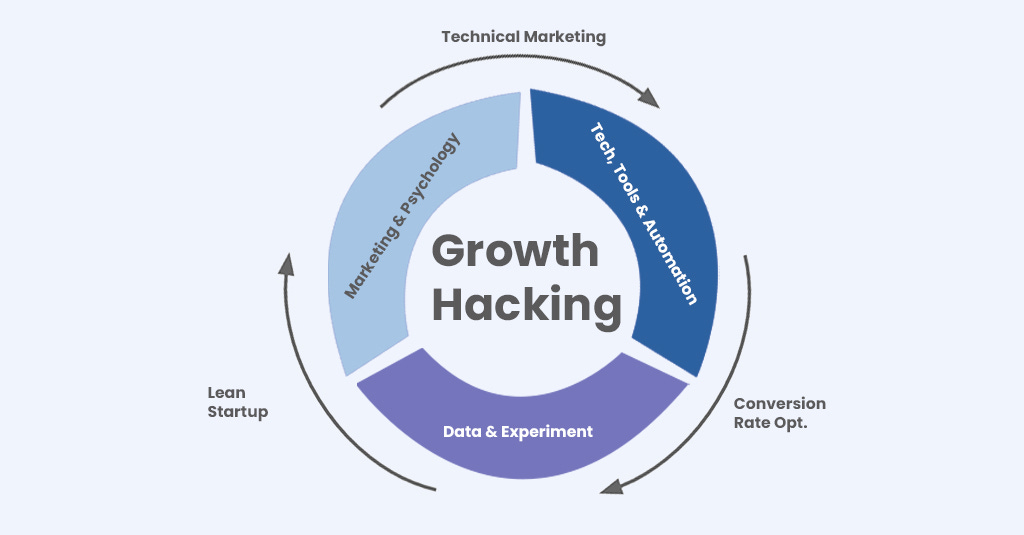
Growth Hacking
What's this all about?

We’ve all heard the term “growth hacking.” This article is intended to describe what growth hacking is, how it is used, and some of its pitfalls. Reminder: there is no fast and easy way to start up growth and indeed, success.
What is growth hacking?
Growth hacking (also known as 'growth marketing') is the use of resource-light and cost-effective digital marketing tactics to help grow and retain an active user base, sell products, and gain exposure. Think ‘hacking’ in terms of life hacks – those little shortcuts that make your life easier – rather than nasty bits of code that can ruin your computer and your life.
Growth hacking is most commonly associated with start-ups and small businesses, i.e., those organizations that don’t have a huge amount of cash to spare but need results quickly. However, it’s a scalable concept applicable to any online business looking to maintain the growth and retention of an active user base.
The strategies startups use to grow their businesses really depend on the business they are in. For example, if the business is in the technology sector, some of the more common strategies that startups use to grow their businesses include angel and venture capital funding, developing an innovative product or service, and partnering with other businesses. However, the strategies a startup uses to grow its business are always completely dependent on the specific situation and needs of that particular business.
What factors limit startups' growth?
1. Limited capital - The first and most common limitation to startup growth is a lack of available capital. This can occur for a variety of reasons, such as a lack of funding options, a smaller pool of investors, or an unwillingness of established businesses to invest in early-stage startups.
2. Limited resources - A second limitation to startup growth is a lack of resources. This can be anything from limited manpower to inadequate technological infrastructure.
3. Limited skills and resources - A third limitation to startup growth is a lack of skills and resources. This can be a challenge when trying to staff a startup with the right mix of abilities and knowledge.
4. Limited time and resources - A fourth limitation to startup growth is a limited amount of time and resources. This can be a challenge when trying to develop a product or find new customers.
5. Limited market potential - A fifth limitation to startup growth is limited market potential. This can be the result of a lack of awareness or limited reach.
6. Limited opportunity - A sixth limitation to startup growth is limited opportunity. This can be the result of a lack of skills or a lack of innovation.
7. Limited market competition - A seventh limitation to startup growth is limited market competition. This can be the result of a lack of resources or limited market potential.
Growth hacks
There are a lot of free growth hacks startups can use to grow their business, without spending a lot of money. One great way to save money is to use free services for market research. startups can also use free tools to improve their website, pricing strategies, and marketing campaigns. Additionally, many startups can save money by using inexpensive software, hiring freelancers, and outsourcing certain tasks.
1. Use free or low-cost tools to improve website speed and accessibility.
2. Conduct online research to identify target demographics and key content areas.
3. Use social media platforms to widen the reach of your content and build a following.
4. Use email list-building techniques to cultivate relationships with potential subscribers.
5. Use online PR and online advertising to reach a larger audience.
6. Utilize Wi-Fi and open wi-fi networks in public places to attract new visitors.
7. Use video content to capture and retain attention from potential and current subscribers.
8. Use blog content to build an audience around specific topics or industries.
9. Use contest and giveaway technologies to generate new subscribers.
10. Use social media management tools to measure results and track growth.
The pitfalls of "growth hacking"
There is no doubt that growth hacking is an effective strategy for growing a company. However, there are many risks associated with this approach. Many growth hacks are created hastily and without proper research. This can lead to ineffective and unscientific solutions that can damage a company’s credibility and lead to inferior results.
Another danger of growth hacking is that it can become a tool to over-promote or hype a product or service. This can lead to disillusionment among users and potential customers, damaging a company’s reputation and bottom line.
There are also risks to growth hacking techniques that are employed in order to circumvent or bypass established regulations or legal hurdles. Experiments that break the law may have serious consequences for a company and its employees.
Some of the most important things to remember when using growth hacks are to always be mindful of the consequences and to take precautions to avoid any potential problems.
Some reputable growth hackers
Buffer, Hootsuite, Kissmetrics, Mixpanel, Baremetrics, Sprout Social, LeadPages, Growthhackers.net, and Moz.
To learn about my real-life company, Pillar, take a look: Pillar